ENTRY 1001 · Between the Lakes · Land Between the Lakes
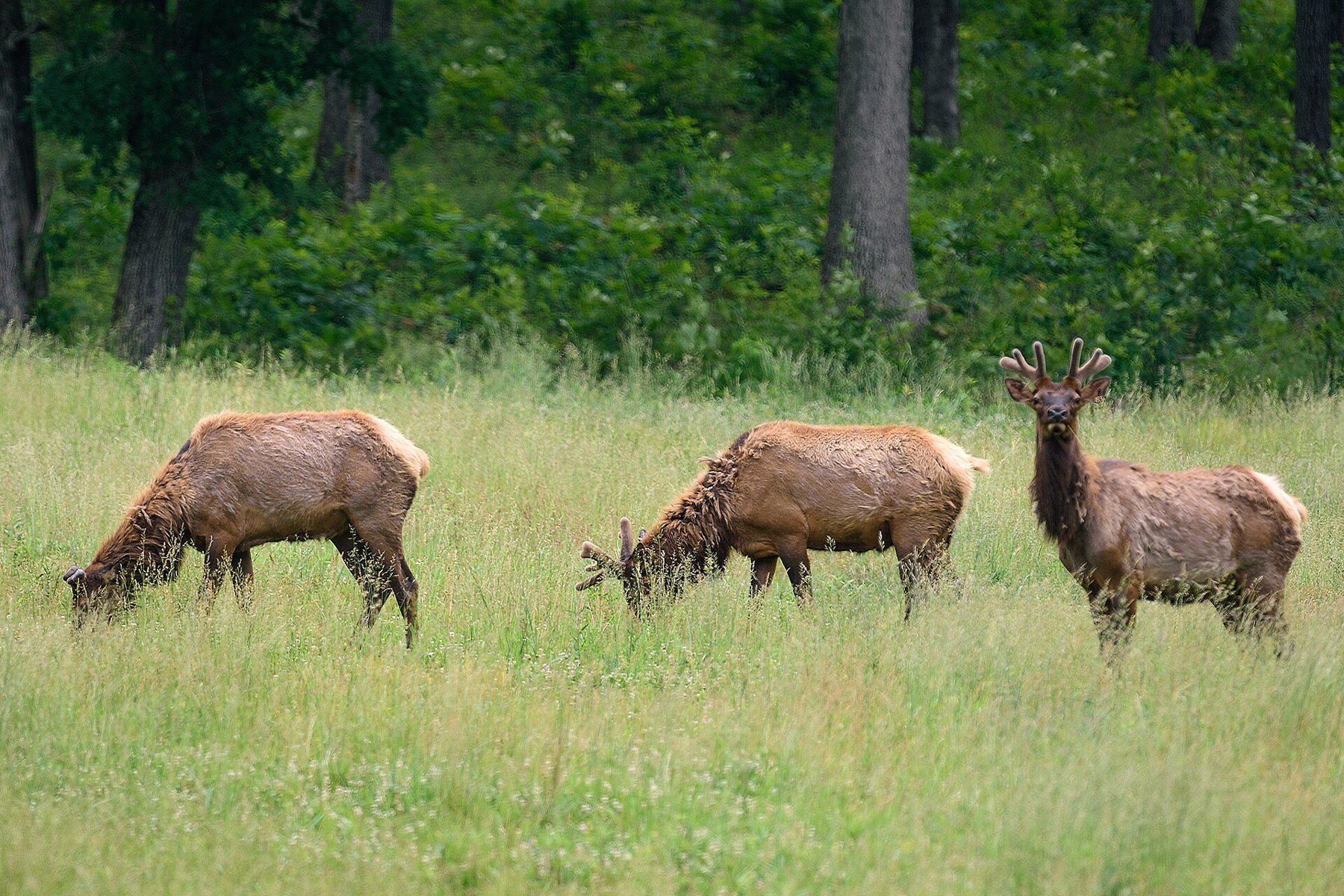
Elk and bison prairie at dusk
A slow loop drive through a restored prairie between Kentucky Lake and Lake Barkley, timed for the last hour of light, when elk and bison come out of the trees.
i
Russ · CC BY 2.0Land Between the Lakes is a long, wooded peninsula between Kentucky Lake and Lake Barkley, managed by the Forest Service as a national recreation area. Most of it is forest, ridges and quiet shoreline. Near the middle, close to Golden Pond, lies a stretch of open grassland where elk and bison roam: the Elk and Bison Prairie.
The prairie is a fenced area of restored grassland and woods, with a paved loop road that visitors drive through in their own vehicles. Elk and bison were native to this part of Kentucky long ago and disappeared from it with settlement. The prairie brings them back to a landscape that looks something like the open barrens and grasslands that once dotted the region.
The prairie took shape in the 1990s, when the Forest Service set aside the land and brought elk and bison back to it. Fire, mowing and grazing keep the grass open and the trees from closing in, much as fire and grazing animals did here long ago. The result is a small window onto a landscape that had been gone from western Kentucky for a very long time.
How the loop works
The drive is simple. You enter through a gate off the Woodlands Trace, the main road that runs north and south along the spine of Land Between the Lakes. A short loop road winds through the prairie, past open grass, scattered trees, small ponds and woodland edges, before bringing you back to the gate.
Visitors stay in their vehicles for the whole drive. Elk and bison are large, wild animals, and bison in particular can be unpredictable. Drive slowly, pull over where it is safe to watch, and never get out or try to approach an animal. There is usually a small fee for the loop, and hours and arrangements can change, so check the Forest Service's current information for Land Between the Lakes before you go.
Signs at the start of the loop and pull-offs along the way explain the prairie and its animals. Allow at least half an hour for the drive, and more if the herds are near the road.
The last hour of light
Like most grazing animals, elk and bison are most active at the edges of the day. During the middle of a hot afternoon, they often rest in the shade of the woods and can be hard to find. As the light fades and the air cools, they move out into the open grass to graze.
That makes the last hour before sunset the best time to drive the loop. Arrive with time to spare, drive slowly, and if you do not see anything the first time, go round again. The herds can move a long way across the prairie in a short time, and a second pass often finds them.
Bring binoculars. Elk often stand at the edges of the trees, and binoculars let you watch their behaviour without crowding them. A camera with a long lens helps too, but the best views are often simply sitting quietly with the engine off.
A few courtesies make the loop better for everyone. Pull fully to the side when you stop, so other cars can pass. Keep voices low, and do not honk, call out or throw anything to get an animal's attention. Never feed the wildlife. Flash photography at dusk startles animals and spoils other people's view, so turn it off. If a bison or elk walks onto the road, stop, wait and let it cross in its own time; they have the right of way here.
Early morning can be good as well, but check the loop's hours, which may not include the first light of the day.
The prairie has more than elk and bison. Wild turkey, deer, and many kinds of birds use the grassland and woodland edges. In spring and summer, wildflowers and grasses fill the prairie; in winter, the open grass is brown, and the animals stand out against it.
ALSO ENTERED · FEBRUARYWinter eagles between the lakes
The rut in autumn
For many visitors, the best season is autumn, when the elk rut. Through September and into October, the bull elk gather groups of cows and challenge rivals, and their high, whistling bugle carries across the prairie at dusk. It is one of the most remarkable sounds in nature, and hearing it in western Kentucky surprises many people.
You will often hear the elk before you see them.
During the rut, bulls are more aggressive and less predictable, so give them extra room and stay in your vehicle at all times. Keep the windows down and the engine off when you stop, and listen. You will often hear the elk before you see them.
Bison have their own breeding season, usually in summer. Bulls may wallow in the dust, bellow and push one another. Watch from a safe distance and enjoy the show.
Autumn is also when the forest around the prairie turns colour, and a drive along the Trace in October is a fine way to spend an afternoon before the prairie loop at dusk.
Along the Trace
The Woodlands Trace is the backbone of Land Between the Lakes, a road that runs the length of the peninsula and is designated a national scenic byway. It links the main sites, and it is the road you will use to reach the prairie.
North of the prairie, the Woodlands Nature Station is a good companion stop. It is an environmental education centre with live animals native to the region, including birds of prey and other animals that cannot return to the wild, along with trails and programmes. It is most often open from spring through autumn, so check the current schedule.
Near the middle of the Trace, the Golden Pond Visitor Center has exhibits, maps, staff who can answer questions, and a planetarium. If you stay out after the prairie closes, the evening sky over the lakes is dark enough for good stargazing, and the dark skies between the lakes make a fine way to end the day.
South of Golden Pond, across the Tennessee line, the Homeplace 1850s farm is a living-history farm that shows how a family in this region lived in the mid-nineteenth century. Bison can also be seen in a range near the Homeplace.
In winter, bald eagles gather along the lakes, and an eagle morning makes a fine pairing with a prairie evening; the guide to winter eagles between the lakes covers where to look.
Planning the visit
- Fill your tank before you enter Land Between the Lakes; services inside are limited.
- Check the Forest Service's current information for hours, fees and any closures.
- Bring binoculars and a camera with a long lens.
- Stay in your vehicle on the loop and give the animals plenty of room.
- Watch for deer and turkey on the Trace as you drive out after dark.
The prairie fits easily into a longer trip. From the lakes, Marion and the Amish country lie to the north and east, and Paducah and Benton lie to the west. Benton holds Tater Day in early April, a spring trade day that pairs well with an evening on the prairie when the grass is new and the calves are young.
But the prairie is best on its own terms: a slow drive, the windows down, and the light going gold over the grass as the herds come out of the trees.
NEXT ON THE CALENDAR · OCTOBER